C-75A
“The Amicus”
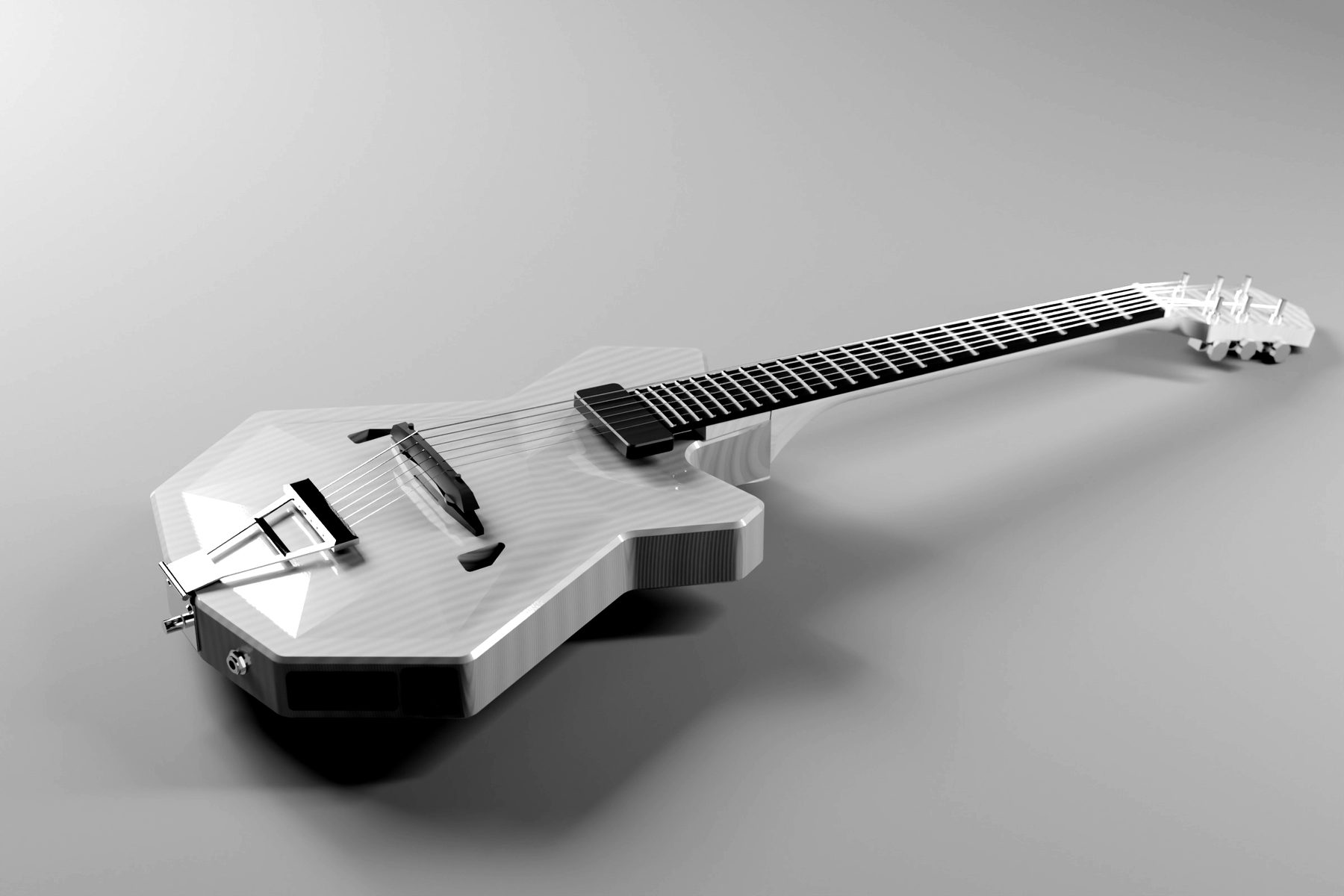
An archtop stringed instrument on outline C-75. Faceted Port Orford cedar top; rim cut whole from one alder blank; arched bigleaf maple back; one pickup hung from the fingerboard. The disclosure relates generally to music, and specifically to this.
| Item | Part | Specification |
|---|---|---|
| 10 | Top | Port Orford cedar, quartersawn. 17 flat facets, graduated 2.8–3.2 mm. |
| 12 | Back | Bigleaf maple, quartersawn. 13 facets, arched 22 mm. Unbraced. |
| 14 | Rim | Red alder, cut whole from one blank. 2.0 deep at the edge. |
| 40 | Neck | Maple, set. ’59 roundback. |
| 42 | Fingerboard | Richlite. |
| — | Frets | 22, nickel silver, 6105. |
| — | Scale | 24.75. |
| 20 | Bridge | Compensated wood top on a 135 mm rosewood base. Floating. |
| 22 | Tailpiece | Trapeze. |
| 24 | Pickup | EMG 91, active, hung from a bracket (26). Alternative: Novak gold foil. |
| 30 | Controls | Stacked volume and tone, concentric knob. |
| 32 | Battery | 9 V in a Gotoh BB-04 box. |
| 34 | Jack | Switchcraft 152B, stereo. |
| 44 | Tuners | Grover Deluxe 133N. |
| — | Finish | Shellac, then oil and wax, rubbed by hand. Solid colours in milk paint beneath. |
| Rev | Description |
|---|---|
| A | Issued for review. Application pending. |
- Dimensions in inches; angles in degrees. DO NOT SCALE DRAWING.
- No unit has been produced. Mass is calculated. It excludes the OPERATOR.
- Every fold in the top is eased inside to 25 mm. No crease is a knife line.
- Every wood is of Pacific Northwest origin. This was not a requirement.
- Depth at the edge is 2.0, as Case No. C-75. The rest is arch.
As defined in C-75-001, Sheet 1, with the following additions.
- Facet
- A flat plane of the top or back. Thirty in all.
- Air
- The contents of the body. Resonant at about 127 Hz. Not supplied separately.
- Machined surfaces
- ±0.005
- Top graduation
- 2.8 to 3.2 mm
- Air resonance
- Approx. 127 Hz. Not adjustable by OPERATOR.
- Non-billable hours
- No upper limit established.
Drawings
Claims
What is claimed is:
- A stringed instrument comprising a rim (14) cut whole from a single blank, a carved top (10), an arched back (12), a set neck (40), a floating bridge (20) and a trapeze tailpiece (22).
- The instrument of claim 1, the top carved as seventeen (17) flat facets, each fold eased inside to a 25 mm radius, each ridge left crisp.
- The instrument of claim 2, the top graduated from 2.8 mm at the plateau to 3.2 mm at the skirt, the bridge base sitting flat on a hexagonal plateau.
- The instrument of claim 2, having two lipped soundholes in the side facets, the air within resonating at about 127 Hz.
- The instrument of claim 1, the top braced by a ring beam, two scalloped tone bars and one cross bar.
- The instrument of claim 1, the back arched in thirteen (13) facets, glued to a ledge routed in the rim, and unbraced.
- The instrument of claim 1, 2.0 deep at the edge, as Case No. C-75, the remaining depth being arch.
- The instrument of claim 1, the neck tenon dropping through a notch in the top, such that the neck is fitted last.
- The instrument of claim 1, having one pickup (24) hung from a bracket (26) beneath a floating fingerboard extension (42), no pickguard being present.
- The instrument of claim 2, the top dyed under shellac, a 1/4 in band at the edge left undyed, constituting binding obtained by the omission of dye.
Conditions of use
Form JPI-75A- For use outside BILLABLE HOURS.
- The pickup (24) is active. Supply 9 V at the battery door (32). No tools are required.
- With the battery exhausted, the INSTRUMENT continues to produce output acoustically. This output is not metered.
- The fingerboard extension (42) floats 15.3 mm above the top. Do not load it.
- Hours of operation are recorded as NON-BILLABLE. Entries to date: none.
Top (10). Do not press the facets to confirm that they are flat. They are flat.
| Audio specimens | Status | |
|---|---|---|
| A | EMG 91 (24) | Not recorded |
| B | Gold foil | Not recorded |
| C | Acoustic | Not recorded |
Specimens will be recorded on the first unit produced.
Manufacture and custody
Procedure JPI-M-1AMade by hands and machines in Portland, Oregon.
- Rim (14) cut whole from one 1-3/4 in alder blank, from the top face, in one setup.
- Top (10) carved in flat planes, graduated, braced and lipped.
- Back (12) carved in facets and glued to the ledge. No linings are kerfed.
- All parts cut on a 3-axis router in one or two setups.
- Neck (40) fitted last.
- On production, the serial is entered in the ledger. No entry has been made.
| Doc. 1 | Machining package: STEP, STL and setup DXFs. | ZIP |
| Doc. 2 | Machining guide. | MD |
| Doc. 3 | Templates. | DXF |
| Doc. 4 | Dimensional report and finite-element report. | JSON |
| Ref. 1 | The carved archtop, with floating bridge and trapeze tailpiece, of the previous century. | Items 10, 20, 22 |
| Ref. 2 | Gold-foil pickup of the DeArmond type, as interpreted by Novak. | Item 24 |
| Ref. 3 | Bridge base of 135 mm, after a Brooklyn maker of the previous century. | Item 20 |
The Corporation claims nothing taught by the prior art. It notes that the prior art was carved by hand, and that this is not.
Allocation
Units: none.
None allocated. The application is pending. Entries are held on file until issue. Fee: to be determined. It has not been determined.
The instrument described in this case file is made by hands and machines in Portland, Oregon, by the builder of record, who has read the drawings and agrees with them. Each instrument carries his signature. Correspondence: [email protected], or on Instagram, @juris_instruments.
Non-billable hours: no upper limit has been established.